



To examine how a structured, phased pre-implementation strategy was used to plan the transfer of the Finnish Smart Family (Neuvokas perhe) lifestyle counselling best practice to six European countries, compare baseline situations and identify lessons for planning the transfer of evidence-based best practices in health promotion across contexts.
MethodA descriptive, comparative pre-implementation study based on document analysis of standardised planning deliverables from six countries. Implementing partners were guided to use common templates, adapted from the previous Joint Action CHRODIS PLUS implementation strategy, to prepare a baseline situation analysis with scope definition, a SWOT analysis, and a pilot action plan. Data were extracted into a cross-country matrix, compared across countries, and validated with country representatives.
ResultsAll countries completed the planned pre-implementation requirements and proceeded to the implementation phase. Countries identified settings where lifestyle counselling was already delivered (primary healthcare, community nursing, schools, and/or digital services). A shared indicator focusing on changes in lifestyle counselling practices was agreed. Common priorities included strengthening professionals’ competence in motivational, strength-based counselling and supporting families’ lifestyle habits and parenting skills.
ConclusionsA structured, phased and template-driven pre-implementation strategy supported comparable planning across diverse contexts and agreement on a shared indicator. Across countries, the plans prioritised strengthening professionals’ counselling competence, supporting families, and integrating health-promoting activities into existing services. Implementation outcomes will be reported separately.
Analizar cómo una estrategia estructurada de preimplementación se utilizó para planificar la transferencia de la buena práctica finlandesa Smart Family (Neuvokas perhe) a seis países europeos, comparar las situaciones de partida e identificar aprendizajes para transferir buenas prácticas de promoción de la salud entre contextos.
MétodoEstudio descriptivo y comparativo basado en el análisis documental de productos de planificación de seis países. Los socios utilizaron plantillas comunes, adaptadas de la estrategia de la Acción Conjunta CHRODIS PLUS, para elaborar un análisis de la situación de partida y del alcance, un análisis SWOT y un plan de acción piloto. Los datos se integraron en una matriz comparativa y se validaron con representantes nacionales.
ResultadosTodos los países completaron los requisitos de preimplementación y pasaron a la fase de implementación. Identificaron ámbitos donde ya se ofrecía asesoramiento sobre estilos de vida: atención primaria, enfermería comunitaria, escuelas y servicios digitales. Se acordó un indicador común sobre cambios en las prácticas de asesoramiento. Las prioridades fueron reforzar las competencias profesionales en asesoramiento motivacional y basado en fortalezas, y apoyar los hábitos de vida y las habilidades parentales de las familias.
ConclusionesLa estrategia estructurada, por fases y basada en plantillas facilitó una planificación comparable en contextos diversos y el acuerdo sobre un indicador común. Los planes priorizaron las competencias profesionales, el apoyo a las familias y la integración de actividades de promoción de la salud en los servicios existentes. Los resultados de la implementación se comunicarán por separado.
Between 1975 and 2016, the prevalence of overweight and obesity among 5-19-year-olds nearly tripled in boys and more than doubled in girls.1,2 In the World Health Organization European Region, nearly one third of children aged 6-9 years (29% of boys and 27% of girls) are living with overweight or obesity.1 Obesity can affect a child's physical and mental health, educational attainment, health in later life and quality of life.2,3 Obesity often continues into adulthood.4 Children with overweight/obesity who also have obesity in adulthood have increased risks of adverse cardiometabolic outcomes.5 Previous research shows that children with overweight or obesity who reach a healthy weight in adulthood have similar risks to those who were never obese.5 Therefore, early prevention and treatment of childhood overweight and obesity are essential for present and future health.
An “obesogenic environment” comprises interacting physical, economic and sociocultural factors that shape eating and physical activity beyond individual choice and contribute to childhood obesity.6 These conditions interact with social determinants of health, reinforcing socioeconomic inequalities in childhood obesity.7 Preventing and treating childhood obesity requires multidisciplinary action on social determinants of health.8,9 Effective prevention requires supporting families and professionals in settings that shape children's everyday lives. Strategies are needed to support the implementation and transfer of effective practices within and across countries and cultures.10,11 International collaboration and knowledge exchange can play a significant role in adapting practices across contexts.
The Joint Action for the implementation of best practices and research results on healthy lifestyles for health promotion and the prevention of non-communicable diseases and risk factors (Health4EUKids) aimed to promote healthy lifestyles and prevent childhood obesity among families with children. Two best practices were selected for implementation: Grunau Moves and Smart Family (originally Neuvokas perhe).12
The objectives of Smart Family are aligned with international policies and recommendations on health promotion and obesity prevention.1–3,8 The practice has been recognised as an EU Best Practice13 and as an effective practice in Finland.14 It builds on national Finnish recommendations for lifestyle counselling, which emphasise assessing the initial situation, information exchange, goal setting, planning, monitoring and feedback.14 Smart Family translates these components into a practical, multilevel and family-centered counselling approach for professionals working with children aged 0–12 years and their families.15,16
In Finland, Smart Family is integrated into the daily work of professionals in maternity and child welfare clinics, schools, early childhood education, and oral health services, primarily through public health nurses, reaching approximately 90% of Finnish families. The approach in the Smart Family practice recognises that immediate biometric changes, such as weight reduction, are difficult to achieve and measure in the short term, and therefore priorities initiating a process of positive development.15,16 It trains professionals to use motivational interviewing, recognise families’ strengths and resources, and support autonomy and self-efficacy in lifestyle choices. The practice includes structured and semi-structured counselling tools, such as visual self-assessment instruments, goal-setting worksheets and thematic materials, which translate its theoretical basis into concrete family-centered counselling interactions.15,16 National development, professional training and materials are funded by the non-governmental Finnish Heart Association, with partial external public-sector and project-based support.17
Smart Family is informed by evidence from the STRIP study, which showed that sustained and repeated lifestyle counselling can lead to lasting improvements in cardiovascular risk factors in children and families.18,19 It draws on health psychology theories and a strength-based approach to lifestyle counselling.20,21 Early implementation and evaluation studies suggest that Smart Family tools can help initiate conversations about physical activity and dietary habits, and that parents supported by trained public health nurses more strongly perceived that their family's lifestyle-related strengths were recognised compared with usual counselling.22,23 Recognising these strengths may support self-efficacy and autonomy, both established predictors of sustained behaviour change.20,24,25
Translating these mechanisms into new national and cultural contexts is not straightforward. Most implementation efforts fail before any service reaches its intended recipients, and the completeness of pre-implementation activity has been shown to predict whether programmes start up and are delivered competently. In an analysis of 1,287 sites across twenty-seven evidence-informed programmes, pre-implementation process fidelity was significantly associated with these downstream milestones.26
This study examines the pre-implementation planning of the Finnish Smart Family practice across six European countries: Croatia, Greece, Lithuania, Poland, Slovenia, and Spain. The study aims to:
- •
Examine how a common implementation strategy was used to prepare country-specific implementation plans.
- •
Compare the baseline situations of lifestyle counselling provision, perceived facilitators and barriers, and proposed adaptations across the participating countries.
- •
Identify lessons for planning the transfer of evidence-based best practices in health promotion across different countries and contexts.
- •
The study aims to generate implementation knowledge on how evidence-based practices can be prepared for transfer across diverse contexts. Outcomes from the implementation phase will be reported separately.
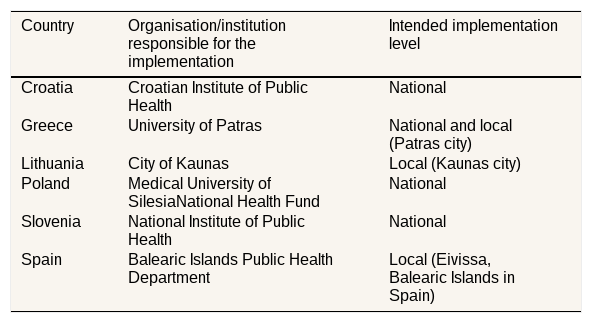
The six Joint Action Health4EUKids countries implementing Smart Family —Croatia, Greece, Lithuania, Poland, Slovenia, and Spain— joined the consortium with designated organisations responsible for piloting the practice during 2023–2025 (Table 1). These organisations were authorised to define the implementation level, appoint leads and form teams to work with relevant services and target groups.
Organisations or institutions responsible for the implementation of the Smart Family in Health4EUKIDS and the intended level for implementation.
| Country | Organisation/institution responsible for the implementation | Intended implementation level |
|---|---|---|
| Croatia | Croatian Institute of Public Health | National |
| Greece | University of Patras | National and local (Patras city) |
| Lithuania | City of Kaunas | Local (Kaunas city) |
| Poland | Medical University of SilesiaNational Health Fund | National |
| Slovenia | National Institute of Public Health | National |
| Spain | Balearic Islands Public Health Department | Local (Eivissa, Balearic Islands in Spain) |
To support the transfer and implementation of the Smart Family, the implementing teams were guided to use an adapted three-phase implementation strategy that was developed and evaluated in a previous Joint Action, CHRODIS PLUS.11,27 It provides a structured, phased and template-based pre-implementation approach built on scope analysis, SWOT analysis, and pilot action planning. It was previously operationalised and reported across several European pilot sites, which supports its use as a standardised and replicable method.11,27,31
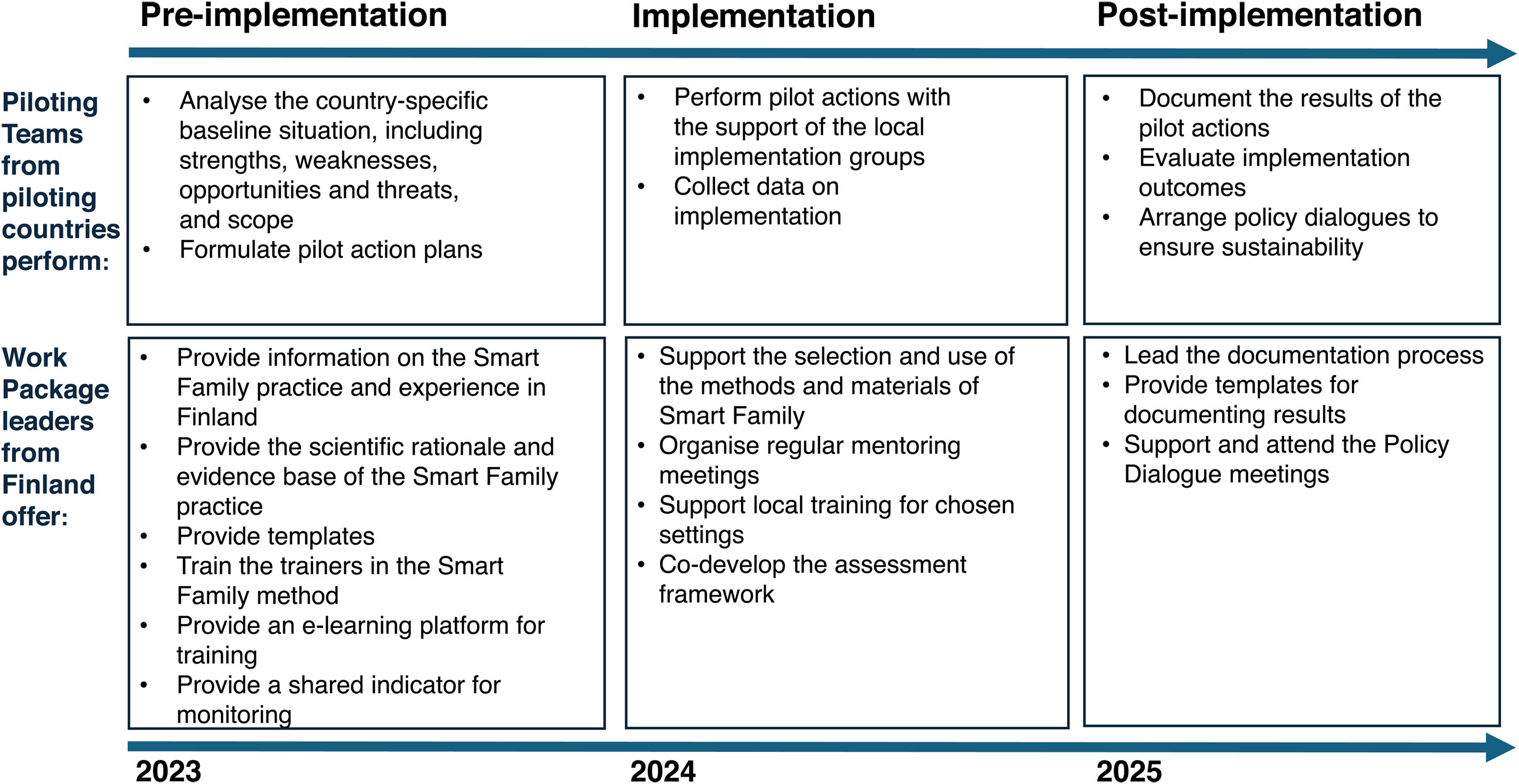
Finnish experts supported country teams by adapting the strategy and providing scientific rationale, knowledge, training, materials, and mentoring. Country teams were guided to use common templates to produce the pre-implementation deliverables and adapt them to their national contexts, resources, and selected settings. To retain flexibility, no strict protocol was applied. Draft deliverables were refined through mentoring meetings with Finnish work package leaders and monthly peer-exchange meetings. Figure 1 summarises the key steps of the implementation strategy.
The implementation strategy of Smart Family in Joint Action Health4EUKIDS. Strategy is adapted from the implementation strategy used in the CHRODIS PLUS project.11,27.
The units of analysis were the country-specific planning documents produced by the implementing teams during the pre-implementation process.
A standardised set of core templates was developed, comprising:
- •
A baseline situation analysis describing existing lifestyle counselling provision and relevant policies.
- •
A scope definition specifying the target population, implementation setting, implementing professionals, and anticipated reach.
- •
A SWOT analysis assessing the strengths, weaknesses, opportunities, and threats related to the proposed implementation.
- •
A pilot action plan framework outlining priority areas for improvement, objectives, change packages, timelines, and indicators.
Documents produced and submitted by all participating countries during the pre-implementation phase were analysed by five researchers and stored in the shared digital workspace.
Qualitative content analysis was used to identify and compare implementation prerequisites, contextual barriers and facilitators, planned adaptations, implementation settings, target groups, professional roles, and anticipated reach. A common analytical framework was developed from the predefined planning templates. Data from each country were extracted into a structured comparison matrix, and compared to identify similarities, differences, and recurring implementation themes. Differences in interpretation were discussed among the research team and resolved through consensus.
The authors held dual roles as national implementation team leaders or work package leaders within the Joint Action. Their involvement provided contextual knowledge that supported the interpretation of the documentary findings and informed research-team reflexivity.
Ethical considerationsThe study is based on the analysis of planning and implementation documents and does not involve medical experimentation, interventions on human participants or animals, nor the analysis of individual-level personal data. Therefore, ethical committee approval was not required for the purposes of this study. Although professional self-evaluation questionnaires were used as part of the implementation activities, the individual-level data derived from these questionnaires are not the subject of the present article.
ResultsApplication of the common pre-implementation strategyAll teams from the six implementing countries completed the pre-implementation phase in a given schedule following the common implementation strategy, which guided and phased the planning process, and produced the agreed deliverables, including comprehensive baseline situation analyses, SWOT analyses, and implementation plans. Detailed country-level descriptions are provided in Supplementary Tables S1–S4.
Baseline lifestyle counselling recommendations and trainingImplementing teams compiled existing recommendations on lifestyle counselling and prerequisite training of professionals in the selected settings, including official guidance on the delivery of lifestyle counselling in health, social care, or educational services. In this context, “recommendations” refers specifically to national-level guidance or official recommendations on how lifestyle counselling should be provided in services, rather than to general healthy lifestyle recommendations, health promotion programmes, or professional training programmes. Implementing teams from Poland, Slovenia and Spain identified specific recommendations for conducting lifestyle counselling in their countries, whereas the teams from Croatia, Lithuania, and Greece reported that such recommendations did not exist in these countries. According to the implementing teams, training for professionals on how to conduct lifestyle counselling was not systematically embedded in the service systems of the countries, and the situation among the countries varied.
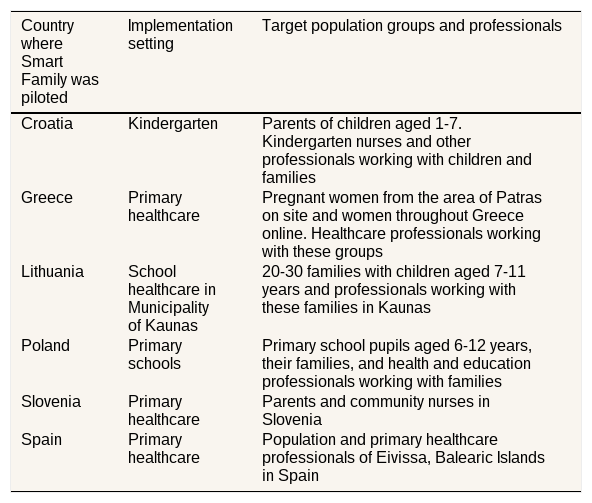
Baseline lifestyle counselling provision, selected implementation settings, and target groupsThe implementing teams documented that lifestyle counselling was already being delivered in their countries within primary healthcare and/or kindergarten, school, and community settings (Supplementary Table S1). Hence, the implementing teams in each country selected implementation sites that could realistically reach families with children and where professionals held an existing counselling role (e.g., nurses, physicians, public health specialists, teachers, psychologists, and dietitians). Table 2 summarises the main implementation settings, target professionals and population groups chosen for piloting in each country. Settings ranged from kindergartens and schools to primary healthcare, involving teachers, healthcare professionals and others working with families.
Summary of selected settings and target groups of Smart Family piloting process of each country during pre-implementation.
| Country where Smart Family was piloted | Implementation setting | Target population groups and professionals |
|---|---|---|
| Croatia | Kindergarten | Parents of children aged 1-7. Kindergarten nurses and other professionals working with children and families |
| Greece | Primary healthcare | Pregnant women from the area of Patras on site and women throughout Greece online. Healthcare professionals working with these groups |
| Lithuania | School healthcare in Municipality of Kaunas | 20-30 families with children aged 7-11 years and professionals working with these families in Kaunas |
| Poland | Primary schools | Primary school pupils aged 6-12 years, their families, and health and education professionals working with families |
| Slovenia | Primary healthcare | Parents and community nurses in Slovenia |
| Spain | Primary healthcare | Population and primary healthcare professionals of Eivissa, Balearic Islands in Spain |
A shared aim was to empower families to make healthier lifestyle choices and strengthen parenting skills by enhancing the way professionals interact with and support them (Supplementary Table S2).
Common facilitators, barriers, and planned adaptationsA synthesis of countries’ SWOT analyses revealed facilitators and barriers at the baseline of implementation (Supplementary Table S3). Common facilitators included experienced multidisciplinary implementation teams, existing national/regional health promotion programmes and existing professionals providing lifestyle counselling. Common barriers were limited time and workforce capacity in routine services, challenges in intersectoral coordination and variability, and gaps in data on childhood overweight and obesity. Economic constraints affecting families’ ability to perform healthy lifestyles were identified indicating that accessibility and affordability of healthy lifestyle options were significant concerns. The SWOT analyses were country-generated planning documents, and the classification of factors into strengths, weaknesses, opportunities, and threats reflected the implementation teams’ own interpretations of their contexts at the time of planning. Therefore, the level of specificity and the distinction between internal and external factors varied between countries, which limits the precision of cross-country comparisons.
In the pre-implementation pilot action plans (Supplementary Table S4) participating countries reported desired improvement areas under which specific objectives were formulated, and actions, referred to as “change packages”, were defined. These pilot action plans served as guidelines for the implementation of interventions. Although pilot action plans were tailored to fit local priorities and target populations, planned actions clustered into three shared “change packages”: 1) training and capacity building for professionals (e.g. nurses, educators, and healthcare practitioners) in strength-based counselling and to integrate Smart Family methods and counselling skills into their daily work; 2) translation, cultural adaptation and dissemination of Smart Family materials to families; and 3) integration of Smart Family activities into existing service pathways (e.g. routine nurse home visits, school health programmes, or primary care counselling). The countries also planned to strengthen early childhood and family wellbeing through health-promoting environments.
Shared evaluation approach and indicatorAs a part of the pre-implementation phase systematic monitoring and evaluation were included in each country's pilot action plan. All implementing teams agreed to monitor a shared key performance indicator focused on the counselling process: change in professionals’ self-assessed quality of lifestyle counselling. The partners chose to assess professionals’ motivation and capability using a modified version of the “Encouraging Professional” self-evaluation checklist,28 adapted into a Likert-scale questionnaire. The checklist is based on the validated Health Care Climate Questionnaire.29 Target professionals were to complete the questionnaire before and after implementation to assess change. Each country also defined complementary local indicators aligned with their pilot actions (e.g., training participation, reach of professionals or families, or specific behaviour-related aims).
DiscussionHealth promotion activities are often strengthened through project-based development,30 but fixed schedules and funding periods require effective planning and structured implementation. Carefully designed implementation strategies can enhance implementation success,11,27,31,32 and pre-implementation is a consequential phase in which contextual determinants of later outcomes are established.27,33,34 This study suggests that pre-implementation can function not merely as preparation, but as a mechanism for structuring and comparing the transfer of best practices across countries. The previously tested CHRODIS PLUS implementation strategy11,27 provided a framework for systematically analysing baseline situations and planning the context-sensitive transfer of Smart Family across six countries. Shared templates supported comparability by identifying common implementation needs and context-specific differences, while ongoing mentoring from the original Finnish developers helped partners distinguish the core elements of Smart Family from local adaptations and translate them into feasible plans. Transparent reporting of this process also addresses a recognised gap in how transfers of public health best practices are described.34
Implementing best practices is inherently complex,35 particularly across national and cultural contexts. The participating countries differed in their settings, target populations, professional roles, governance, institutional mandates, and data availability. Lifestyle counselling was delivered in both healthcare and education by multiple professional groups but was not consistently supported by national or institutional guidance or systematic training. However, professionals already working with children and families provided a basis for developing motivational, strength-based lifestyle counselling.
Country-level differences shaped what was feasible. Countries with established programmes or structured prevention pathways could integrate Smart Family into routine work, whereas others relied more on project-based delivery. Implementing teams also differed in their institutional mandates, ranging from universities and municipalities to national research institutes under ministries. These findings are consistent with implementation science literature showing that context and system complexity influence feasibility and adaptation.35,36
Planning to integrate Smart Family into established health promotion frameworks and professional education structures may promote local ownership and create more favourable conditions for longer-term continuity. Moreover, identifying ongoing or upcoming initiatives during the planning phase may allow the implementation to be aligned with existing developments, making it timelier and more efficient, although these outcomes require subsequent evaluation.
These findings illustrate the importance of understanding the “black box” between research and practice. Implementation science seeks to explain how evidence-based interventions can be integrated into routine practice, considering contextual constraints, organizational capacities, and professional roles.36,37 The structured pre-implementation process used in this study enabled countries to identify contextual factors early and tailor their plans accordingly, consistent with previous research.38
Cross-country exchange can support learning and contextual adaptation by facilitating the exchange of knowledge and ideas.39 In this study, shared learning helped identify potentially feasible implementation pathways and develop a common understanding of how Smart Family might be adapted while retaining its core principle: the motivational, strength-based approach to lifestyle counselling. Understanding the core of the best practice in terms of why it works, what principles underpin it, and under which conditions it can achieve similar outcomes elsewhere is important. Transferring a Finnish best practice requires cultural and contextual adaptation to succeed in other countries. The Finnish partners played a significant role by providing guidance, templates, materials, and feedback on implementation plans. This support helped implementing teams understand that transferring Smart Family required changes in professional counselling practices, not only the provision of health information or materials to families. The findings suggest that support from original developers may facilitate transfer to new contexts, consistent with previous studies using similar methodology,11,27 but requires further investigation.
All piloting countries planned to promote multisectoral collaboration by engaging professionals from health, education, and community sectors with the intention to build supportive networks around families and contribute to health-promoting communities and environments. Such multisectoral action is widely recommended in childhood obesity prevention.8 However, as this study focuses on pre-implementation planning documents and processes, the findings do not establish whether the planned adaptations will result in successful implementation, sustained delivery, or long-term transferability of the Smart Family practice. Rather, they identify conditions and mechanisms that may support these outcomes. Implementation fidelity, the effects of local adaptations, sustainability, and longer-term integration into routine practice should therefore be examined in subsequent implementation and outcome evaluations.
The shared indicator may support future evaluation of fidelity to the core elements of the Smart Family practice by focusing on the counselling process rather than on context-specific outputs. As a self-reported measure, it may be subject to social desirability bias and does not capture observed counselling practice or family-level outcomes. It is therefore appropriate to the pre-implementation and early implementation context and should be complemented by observational and outcome measures in subsequent evaluation.
This study has several limitations. EU Joint Actions are not primarily research projects, and the analysed documents were produced to support implementation planning rather than research. Reporting depth and specificity varies between countries, which may increase the risk of selective reporting and limit the precision of cross-country comparisons. The SWOT analyses were also country-generated, and the classification of factors reflected country teams’ own interpretations of their contexts. In addition, the authors functioned as implementers or work package leaders, which may have introduced insider or observer bias. Finally, although common templates were used, a strict protocol was not applied to preserve flexibility. This flexibility supported local adaptation but made standardised cross-country transfer more demanding.
Differences in service structures, professional roles, and local governance added further complexity to the planning of the implementation across countries. The cross-country variation suggests that balancing local adaptation with fidelity to the core elements of the practice is most likely to remain a central challenge for sustainable cross-country transfer. Subsequent phases should include systematic documentation of adaptations to determine their implications for fidelity, feasibility, and sustainability. The template-driven approach used in this study could also be further developed into a transferable toolkit to support future international implementation projects.
The planning process highlights the tension between adaptation and fidelity: how to tailor a best practice to new contexts while retaining its core identity. The sustainability and long-term feasibility of these adaptations should be assessed in future evaluations.
ConclusionsThe pre-implementation phase of the Smart Family implementation strategy appeared useful for structuring planning across six European countries with diverse health-system configurations. It enabled implementing teams to define goals and actions, consider local contexts and develop country-specific implementation plans using a shared framework. To our knowledge, this represents one of the first simultaneous multi-country applications of the CHRODIS PLUS implementation strategy to a family-oriented lifestyle counselling practice. Across countries, the plans shared an emphasis on strengthening professionals’ counselling competence, supporting families, and integrating Smart Family activities into existing service pathways.
Availability of databases and material for replicationThere is no online material available for replication. For additional content, please contact the author.
Evidence shows that transferring and implementing best practices in health promotion across countries is complex and context-dependent, requiring systematic strategies and adaptation frameworks.
What does this study add to the literature?This study describes how a structured planning process was applied to guide the cross-country transfer of a lifestyle counselling practice and compare implementation prerequisites.
What are the implications of the results?Structured planning and continued involvement of original developers may support context-sensitive adaptation when transferring best practices internationally.
Jorge Marcos-Marcos.
Transparency declarationThe corresponding author, on behalf of the other authors guarantee the accuracy, transparency and honesty of the data and information contained in the study, that no relevant information has been omitted and that all discrepancies between authors have been adequately resolved and described.
Authorship contributionsN. Savolainen: study conception and design, data gathering, data analysis and interpretation, article writing and critical reviewing. M. Lang Morović: study conception and design, data gathering, data analysis and interpretation, article writing and critical reviewing. S. Meštrić: study conception and design, data gathering, data analysis and interpretation, article writing and critical reviewing. E. Magriplis: study conception and design, data gathering, data analysis and interpretation, article writing and critical reviewing. M.J. Ramos Monserrat: study conception and design, data gathering, data analysis and interpretation, article writing and critical reviewing. M. Mutter: study conception and design, data gathering, data analysis and interpretation, article writing and critical reviewing. T. Sainio: study conception and design, data gathering, data analysis and interpretation, article writing and critical reviewing. E. Koivurinta: data curation, editing, reviewing. H. Kuusipalo: resources and supervision, data analysis and interpretation. J. Nowak: study conception and design, data gathering, data analysis and interpretation, article writing and critical reviewing. P. Mäki: study conception and design, data gathering, data analysis and interpretation, article writing and critical reviewing. All authors have read and agreed to the published version of the manuscript.
AcknowledgementsThe authors would like to acknowledge Professor Apostolos Vantarakis from the University of Patras for his work as a leader of the Joint Action Health4EUKids and the following people in addition to the authors, who participated in the project group of Work Package 6 in Health4EUKids: Kati Kuisma, Carmen Ortiz Martínez, Sabina Torne, María Belén Peris, Agata Szymczak, Anja Bohinec, Katarzyna Brukało, Vasiliki Iliopoulou, Georgios Karydas, Kyriaki Premtou, Lamprini Lachanioti and Tautvydas Lukavicius.
FundingThe authors declare financial support was received for the research, authorship, and publication of this article. Project: Health4EUKids, received funding from the European Union's EU4HEALTH Program under the Grant Agreement no 101082462.
Conflicts of interestNone.